13
Thu, Nov
69 New Articles

In the CEE region, law firms are facing a growing challenge: the legal profession is no longer as attractive to younger generations as it once was. Law school enrollment is declining, and those who do enter the field often question its long-term viability. The reasons are familiar: demanding studies, pressures of the job, long hours, slow progression, and increasing doubt about whether this is a profession that will remain relevant in the age of artificial intelligence.

In The Corner Office, we ask Managing Partners at law firms across Central and Eastern Europe about their backgrounds, strategies, and responsibilities. This time around, we asked: If you were to hire a new receptionist tomorrow, what is the one most important trait you look for and why?

On November 1, 2024, a canopy collapse at Novi Sad Railway Station claimed 16 lives, with subsequent investigations exposing glaring discrepancies in a multi-million-euro renovation. The disaster has since sparked Serbia’s largest protest movement in decades, as citizens and students mobilize to demand accountability, transparency, and broad systemic reforms.

Schoenherr Partner Igor Zivkovski, ZSP Advokati Partner Jelisaveta Stanisic, Karanovic & Partners Partner Maja Jovancevic Setka, and MMD Advokati Partner Rastko Malisic discuss how, after years of dormancy, Serbia’s exchanges and fund platforms are finally showing signs of life, as institutional and retail actors alike begin to test the waters. While trading volumes and liquidity remain modest, a growing consensus among policymakers and market participants suggests that the capital market’s long-awaited expansion may at last be underway.

As cross-border client needs grow in Southeast Europe, Kinstellar launched the Western Balkans Hub to offer legal support across the region. SOG in cooperation with Kinstellar Managing Partner Milos Velimirovic and Special Counsel Olga Sipka discuss how the Hub came to life, how it works in practice, and what sets it apart.

In Serbia’s real estate market, cultural tradition, financial caution, and limited alternatives intersect to create a unique investment landscape. NKO Partners Partner Branko Jankovic, BDK Advokati Partner Jelena Hrle, Bojovic Attorneys at Law Partner Marija Bojovic, Radovanovic Stojanovic & Partners Partner Milorad Gajic, and Gecic Law Partner Miodrag Jevtic discuss the enduring preference for property as a default investment, the historical experiences that continue to shape investor behavior, and the broader economic and geopolitical factors contributing to rising property prices across the country.

Dunja Hasanovic, Chief Legal Officer of AMA Group, shares insights from her almost two-decade journey in the legal field. Today, she focuses on leading legal projects across the group and monitoring legal and regulatory developments that affect its operations, always working to support both compliance and business needs.

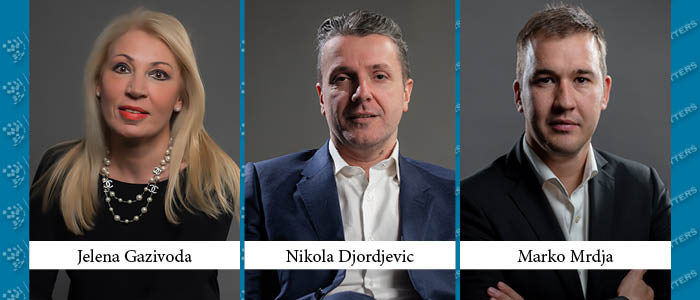
Belgrade is gearing up to host Expo Belgrade 2027 (Expo 2027), a first-of-its-kind specialized exhibition for Serbia and the Western Balkans. With major infrastructure projects underway and over EUR 1 billion in projected gains, the event promises both opportunity and challenges, according to JPM & Partners Senior Partner Jelena Gazivoda and Zivko Mijatovic & Partners Of Counsel Mina Jovanovic Ninkovic.

ODI Law Partner Tine Misic and Peterka & Partners Managing Partner Ondrej Peterka look at Slovenia’s appeal for regional firms’ entry into the market, the Bar Association’s reception, and what it all means for domestic competition.

An in-depth look at Aleksandra Jemc Merc of Jadek & Pensa, covering her career path, education, and top projects as a lawyer as well as a few insights about her as a manager at work and as a person outside the office.

Law No. 05/L-085 on Electricity (2016) provides small commercial entities with access to the so-called Universal Supply Service – the right to remain in the price-regulated energy market. In contrast, large commercial entities must find their energy suppliers licensed by the Energy Regulatory Office (ERO). In commercial terms, this means a transition of the energy market from a single supplier to dozens (currently up to 20). This transition aims to develop the energy market, increase competition, and improve service quality for consumers.

In recent years, Latvia has faced various challenges in the energy sector while simultaneously transposing European Union regulations into national legislation. In May 2025, the Ministry of Climate and Energy (MoCE) developed long-term planning guidelines titled Energy Strategy Latvia 2025. This marks a significant step in implementing domestic energy policy, with the defined objectives including Latvia becoming a regional leader in energy pricing, achieving high energy self-sufficiency, and ensuring that the energy infrastructure in Latvia is used efficiently and sustainably.

The Government of the Republic of Serbia has passed two decrees to ensure security of the supply of natural gas. These are the Decree on determination of the preventive action plan for the purpose of ensuring security of supply of natural gas and the Decree on determination of the crisis plan for the purpose of ensuring security of supply of natural gas.

After a three-year delay, Croatia is hoping to finally implement a unit fee for connecting energy projects to its power grid. Expected by autumn 2025, this change will remove major regulatory barriers and unlock over 2,500 megawatts of stalled renewable energy projects.

The green energy transition is transforming the energy landscape of Hungary and the wider Central and Eastern Europe (CEE) region, presenting both opportunities and challenges. By 2035, the region is expected to be among the leaders in integrated, low-carbon energy systems, driven by innovation, sustainability, and grid flexibility. For Hungary, this shift is especially relevant, offering strategic opportunities for domestic investors.

The Bulgarian energy sector witnessed some fundamental changes over the last five years. These include putting in operation the over 5 gigawatt-hours photovoltaic capacity, with more than 2 additional gigawatt-hours in the pipeline, and the construction of two major natural gas interconnectors (Balkan Stream and ICGB), which are already delivering energy to customers and reshaping the nuclear industry by utilizing Western fuel and equipment.

Page 1 of 2