09
Mon, Mar
36 New Articles

Moldova’s renewable energy sector has taken a decisive step forward in 2025 with the completion of its first competitive auctions for the designation of Large Eligible Electricity Producers. The process, launched under Government Decision No. 690/2018, demonstrated the growing maturity of the country’s regulatory framework and its alignment with EU-style competitive mechanisms for renewable development.

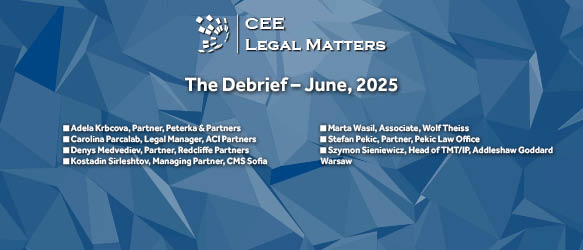
In The Debrief, our Practice Leaders across CEE share updates on recent and upcoming legislation, consider the impact of recent court decisions, showcase landmark projects, and keep our readers apprised of the latest developments impacting their respective practice areas.

The energy sector in CEE has undergone unprecedented transformation since the beginning of Russia’s full-scale invasion of Ukraine in 2022, forcing governments and energy companies to align their economies, businesses, and strategies with energy security objectives, transforming energy landscapes, and keeping legal teams extremely busy. Law firms have found themselves at the center of energy market changes and the renewables revolution that shows no signs of slowing.

As the region rounds the summer bend, Kinstellar Partner in Serbia Milan Samardzic, Avellum Managing Partner Mykola Stetsenko in Ukraine, and PwC Director and Head of Legal Practice in Georgia Vano Gogelia unpack what moved and why in terms of summer levels of activity, the macro and political levers at play, and what they expect to drive closings into year-end.

White & Case Local Partner Jana Chwaszcz, Havel & Partners Partner Jaroslav Baier, DLA Piper Czech Republic Country Managing Partner Miroslav Dubovsky, and Schoenherr Partner Vladimir Cizek discuss the forces behind Czech investors increasingly looking beyond their borders, the sectors and destinations attracting the most interest, and the challenges that come with navigating foreign markets.

As of June 1, 2025, changes in labor law, also known as the “Flexi-Amendment,” came into effect in the Czech Republic, with the purpose of enhancing flexibility in employment relationships and in the labor market. Peterka & Partners Partner Adela Krbcova, Sedlakova Legal Partner David Supej, Glatzova & Co Partner Jiri Sixta, Act Legal Partner Lenka Droscova, and Legalite Partner Marie Jansova discuss how the reforms are shaping the Czech labor market.

An in-depth look at Prokop Verner of  A&O Shearman, covering his career path, education, and top projects as a lawyer as well as a few insights about him as a manager at work and as a person outside the office.

Cechova & Partners Partner Michaela Jurkova and Ruzicka & Partners Partner and Co-Head of the Banking and Finance practice Jan Hanko discuss Slovakia’s banking sector’s modest but meaningful consolidation over the last five years.

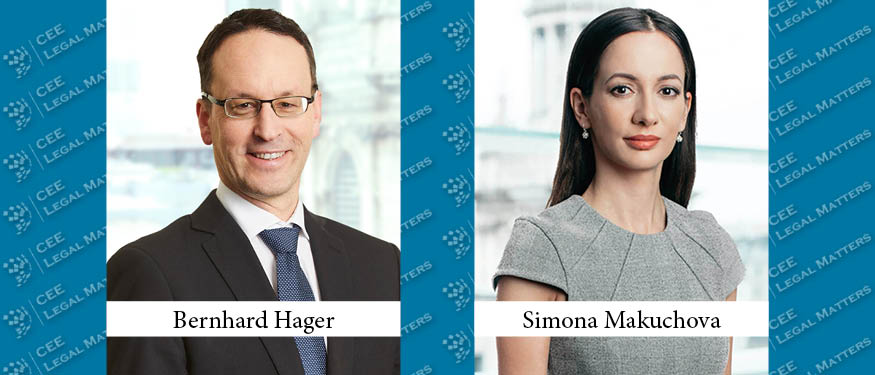
An in-depth look at Bernhard Hager of Eversheds Sutherland, covering his career path, education, and top projects as a lawyer as well as a few insights about him as a manager at work and as a person outside the office.

Corwin Head of Legal Services Department Marek Kundrat discusses balancing legal precision with business agility, the realities of cross-border in-house work, and the shifting regulatory landscape in Slovakia’s real estate sector.

Dark patterns have become a common feature of digital consumer interaction. While their manipulative nature leads to unfair commercial practices, the current applicable regulatory framework and a lack of case law pose challenges to enforcing fair commercial practices by online businesses. A recent court decision in Germany gives the first clarifications by giving an interpretation of the overlaps in scope of the Digital Services Act (DSA) and the Unfair Commercial Practices Directive (UCP Directive).

AI is gradually becoming part of everyday HR practice in Hungary. Tools already support recruitment, onboarding, and talent and performance management. More advanced systems – like AI-powered HR assistants and workforce planning tools – can also be expected.

Romania is nearing full implementation of the NIS2 Directive, with secondary legislation expected to be enacted by the end of this summer. The legal framework is largely in place, and Romanian entities will have to begin their compliance efforts ahead of most other EU jurisdictions.

Slovakia is one of the more active Member States of the EU when it comes to implementing Directive 2022/2555 (NIS2). A substantial amendment (effective from January 1, 2025) to Slovakia’s existing Cybersecurity Act No. 69/2018 introduced a new regulatory framework. Deadlines are now in place and regulatory activity is increasing. Businesses across various sectors, particularly in digital infrastructure, energy, finance, and manufacturing, are expected to adapt to the updated legal landscape rapidly.

2025 may well be remembered as Year Zero for the Serbian telecommunications market – and with good reason.  It marked the acquisition and effective split of Serbia Broadband (SBB), the second-largest player in Serbia’s cable and broadband market, by Telekom Srbija (TS) and Yettel (e&/PPF Telecom Group).